

How does a cyclone dust separator work? A cyclone dust separator removes much of the dust, wood chips, and other debris from an airflow before that air reaches a vacuum filter or dust collector. It uses a spinning airflow to separate particles from the air, allowing heavier debris to fall into a separate collection container while cleaner air continues toward the outlet. This process helps prevent large amounts of sawdust and wood chips from reaching the vacuum filter, reducing filter buildup and helping maintain suction during workshop projects.
Cyclone dust separators are commonly used in woodworking shops, home workshops, industrial manufacturing facilities, and other places where dust and particulate matter need to be controlled. In a small workshop, a cyclone separator is often installed between a power tool and a shop vacuum to capture debris before it enters the vacuum. This setup can make dust collection more convenient by reducing how often you need to empty the vacuum and clean its filter. However, a cyclone separator does not remove every fine dust particle, so the vacuum filter remains important for capturing smaller airborne particles.
But how does this simple-looking device separate dust without a conventional filter inside its main chamber?
The answer involves airflow, particle inertia, centrifugal effects, and the geometry of the separator. Understanding these principles helps explain why cyclone separators work well for wood chips and coarse dust, why some fine particles escape, and how the design affects overall performance.
In this guide, we’ll explain how a cyclone dust separator works, examine its main components, explore the science behind particle separation, and discuss its benefits, limitations, and common problems.
What Is a Cyclone Dust Separator?
A cyclone dust separator is a mechanical device that separates solid particles from an air stream by creating a rotating flow inside a specially shaped chamber.
Instead of forcing all the dust-laden air through a filter, the separator makes the incoming air spin. Particles with sufficient inertia move away from the center of the rotating flow toward the outer wall. They then travel downward into a collection bin or hopper, while the air follows a different path toward the outlet.
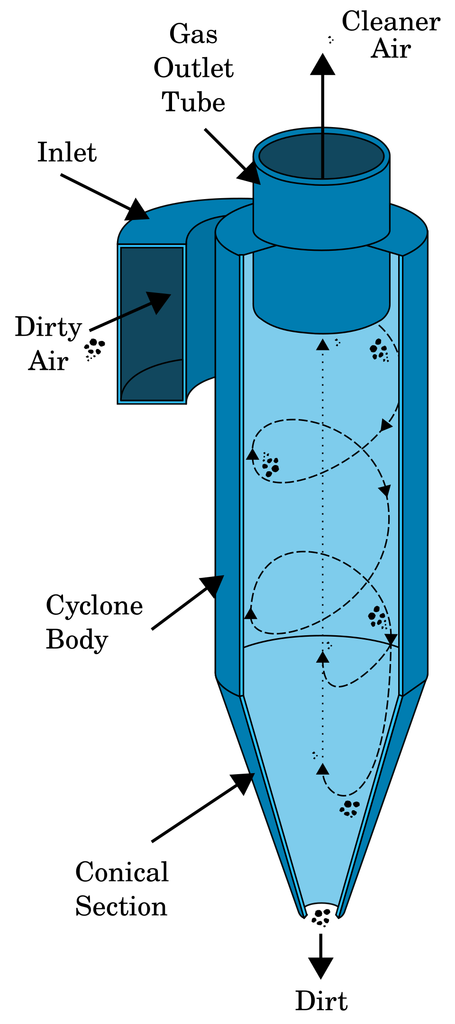
A typical cyclone has a cylindrical upper body, a tapered lower section, a side inlet, a central outlet, and a dust discharge opening.
In a woodworking setup, the arrangement often looks like this:
Woodworking tool → cyclone separator → shop vacuum or dust collector → final filter
The exact configuration depends on the equipment and whether the system exhausts air indoors or outdoors.
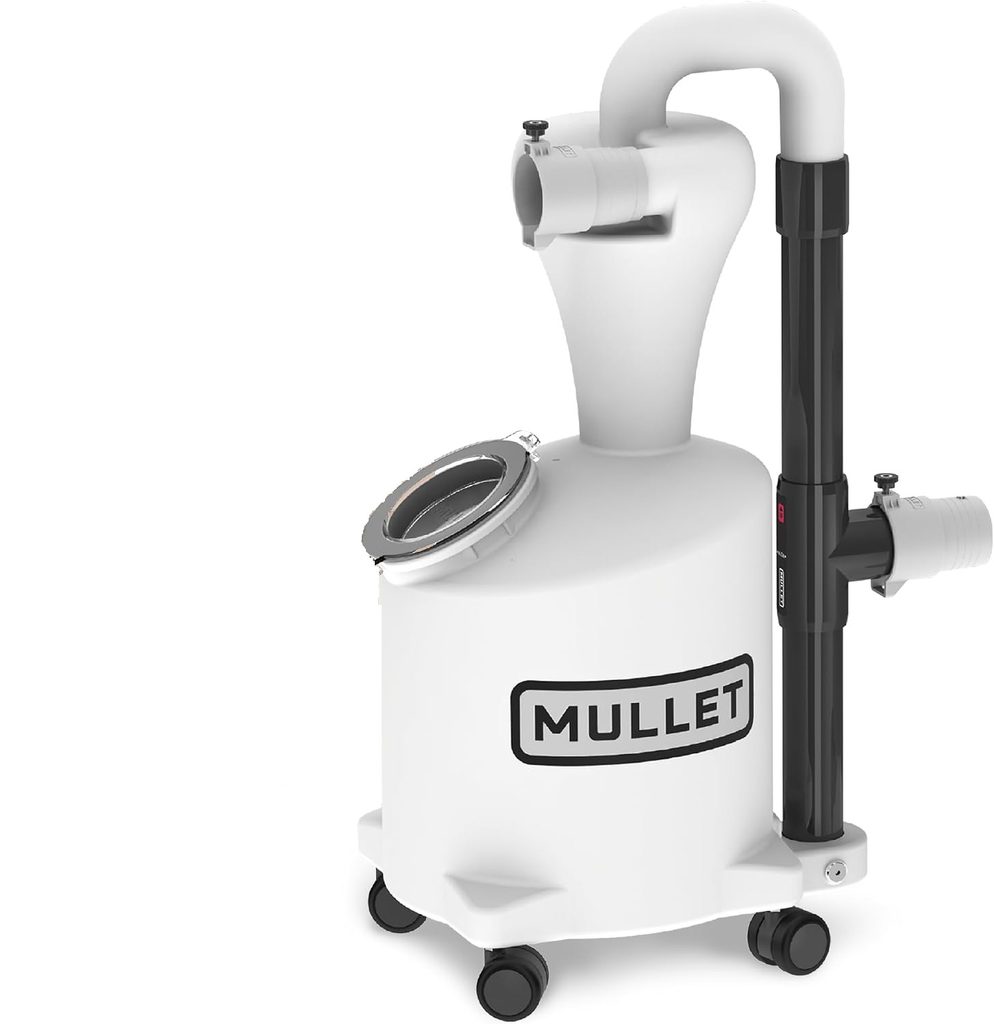
A cyclone separator is generally considered a pre-separator when used with a shop vacuum. Its job is to remove a substantial portion of the incoming debris before it reaches the vacuum’s filter. The filter remains important because the cyclone does not capture every particle.
Industrial cyclone collectors use the same basic principle, although their dimensions, materials, airflow requirements, and discharge systems can be very different from those of a small workshop separator.
How Does a Cyclone Dust Separator Work?
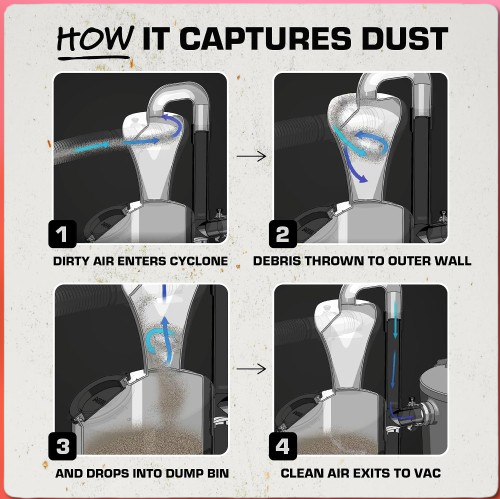
The process begins when dust-laden air enters the separator through a side inlet. The inlet directs the air into a circular path, creating a vortex inside the chamber.
As the air rotates, particles respond differently depending on their size, density, shape, and inertia. Larger particles are generally more likely to move toward the outer wall, while the air and many smaller particles continue through the internal flow.
Here is the process step by step.
Step 1: Dust-Laden Air Enters the Cyclone
Dust enters the system when a tool such as a table saw, sander, planer, or router generates airborne debris. A vacuum or dust collector moves the air through a hose toward the cyclone separator.
The separator’s inlet is typically positioned tangentially, meaning that the incoming air enters along the side of the cylindrical chamber rather than directly toward its center.
This arrangement gives the incoming airflow a rotational component.
For example, when you connect a cyclone separator to a shop vacuum, the vacuum creates the pressure difference that moves the air. The cyclone’s inlet geometry then directs that moving air into a swirling path.
The distinction is important: the cyclone does not create suction by itself. The vacuum or blower supplies the airflow, while the cyclone separates particles from that airflow.
Step 2: The Air Begins to Rotate
Once inside the chamber, the air moves around the central axis, forming a vortex.
Think of water swirling around the inside of a drain, although the cyclone’s internal flow is more complex and involves air rather than water.
The rotating airflow creates a radial pressure gradient and causes particles with sufficient inertia to migrate away from the center. This is commonly explained using centrifugal effects.
The rotation alone does not guarantee effective separation. The chamber’s shape, inlet dimensions, outlet geometry, airflow rate, and particle characteristics all influence the result.
A well-designed cyclone establishes a flow pattern that gives particles enough opportunity to move outward and reach the collection region.
Step 3: Larger Particles Move Toward the Outer Wall
Dust particles do not follow changes in airflow direction as readily as the air itself. Larger or denser particles often have greater inertia, so they resist being carried along the same curved path.
As a result, many of these particles migrate toward the cyclone’s outer wall.
Once a particle reaches the wall, it may lose some of its momentum through contact and friction. The surrounding airflow and gravity then help carry it down the tapered section.
This is why a cyclone can remove wood chips and relatively coarse sawdust effectively under suitable operating conditions.
However, not every particle behaves the same way. A small, lightweight particle may remain suspended in the air and follow the vortex toward the outlet. Particle size and density matter, but particle shape, airflow velocity, and cyclone design also affect separation.
Step 4: The Dust Travels Down the Cone
Many conventional cyclone separators have a conical lower section that narrows toward the dust outlet.
The outer vortex travels downward along the chamber wall. Particles separated from the air are carried toward the bottom and eventually enter the collection bin or hopper.
The cone helps guide the separated material toward the discharge opening.
In a workshop system, the bin may be a bucket or a purpose-built container attached beneath the separator. In an industrial installation, the hopper may be connected to a larger dust-handling system.
The collection container must be compatible with the system’s operating pressure. A weak or poorly supported container can deform under vacuum, and leaks at the container connection can interfere with separation.
Step 5: The Air Reverses Direction and Moves Upward
In a common reverse-flow cyclone, the airflow does not simply continue downward and leave through the bottom.
Instead, much of the air changes direction near the lower part of the chamber and forms an inner vortex that moves upward toward the central outlet.
This produces the characteristic double-vortex flow pattern:
- The outer vortex moves downward near the chamber wall.
- The inner vortex moves upward near the center.
- The central outlet carries the exiting air toward the next stage of the system.
The vortex finder, a tube extending into the upper part of many cyclone designs, helps guide this inner airflow toward the outlet.
The two-vortex pattern is one of the defining features of a conventional reverse-flow cyclone. Other cyclone designs use different flow arrangements, so the exact path depends on the separator type.
Step 6: The Remaining Air Passes to the Filter
After the separation process, the air leaves through the cyclone’s outlet.
In a typical woodworking installation, this air travels to a shop vacuum or dust collector, where a filter captures additional particles that escaped the cyclone.
The cyclone therefore reduces the dust load reaching the filter rather than replacing the filter altogether.
This can reduce how quickly the filter becomes loaded with coarse debris and may make maintenance easier. The amount of improvement depends on the cyclone’s performance, the material being collected, and how the complete system is configured.
For fine dust, suitable filtration remains essential.
Suggested image placement: Add a labeled diagram here showing the tangential inlet, outer downward vortex, inner upward vortex, central outlet, and dust collection bin.
The Science Behind Cyclone Dust Separation
To understand why a cyclone works, it helps to look beyond the spinning motion and examine the forces acting on individual particles.
Three concepts are particularly important: particle inertia, centrifugal effects, and aerodynamic drag. Gravity also contributes to moving separated material toward the collection bin.
1. Centrifugal Effects and Particle Inertia
When air rotates inside a cyclone, particles experience the effects associated with moving along a curved path. In a rotating reference frame, the outward tendency is commonly described as centrifugal force.
In the physical airflow, particles also have inertia: they resist changes in their direction of motion. Because air can change direction more readily than a particle with sufficient inertia, that particle may migrate outward relative to the airflow.
This is the central principle behind cyclone separation.
It is worth understanding that a cyclone does not simply throw every particle outward. The airflow exerts aerodynamic drag on particles, carrying them along with it. Separation occurs when a particle’s inertia and motion relative to the air allow it to migrate toward the wall before the air carries it out through the outlet.
2. Aerodynamic Drag
Aerodynamic drag is the force exerted by moving air on a particle. It influences how closely the particle follows the surrounding airflow.
Small particles generally respond more quickly to changes in air direction than larger particles do. As a result, many fine particles follow the inner airflow and leave through the central outlet.
Larger particles tend to resist changes in direction more strongly. Under suitable conditions, they migrate outward and become separated from the air stream.
This is why cyclone performance depends on more than particle weight alone. Size, shape, density, airflow, and the time available for separation all matter.
3. Gravity
Gravity helps move separated dust and debris down the cyclone’s walls and into the collection bin.
However, gravity is not the primary mechanism that separates suspended particles from the rotating airflow. The cyclone’s rotational flow and particle inertia do most of that work.
Once particles have reached the outer region and lost sufficient momentum, gravity and the downward airflow help carry them toward the discharge.
4. The Role of Air Velocity
Air velocity affects how particles move through the cyclone.
If the airflow is too weak for a particular design, separation may become less effective. Increasing velocity can improve the outward migration of some particles, but it also increases resistance and the power required to move air through the system.
Higher velocity is therefore not automatically better.
The goal is to achieve a suitable operating range for the cyclone’s geometry, the dust being collected, and the capabilities of the connected vacuum or blower.
What Are the Main Parts of a Cyclone Dust Separator?
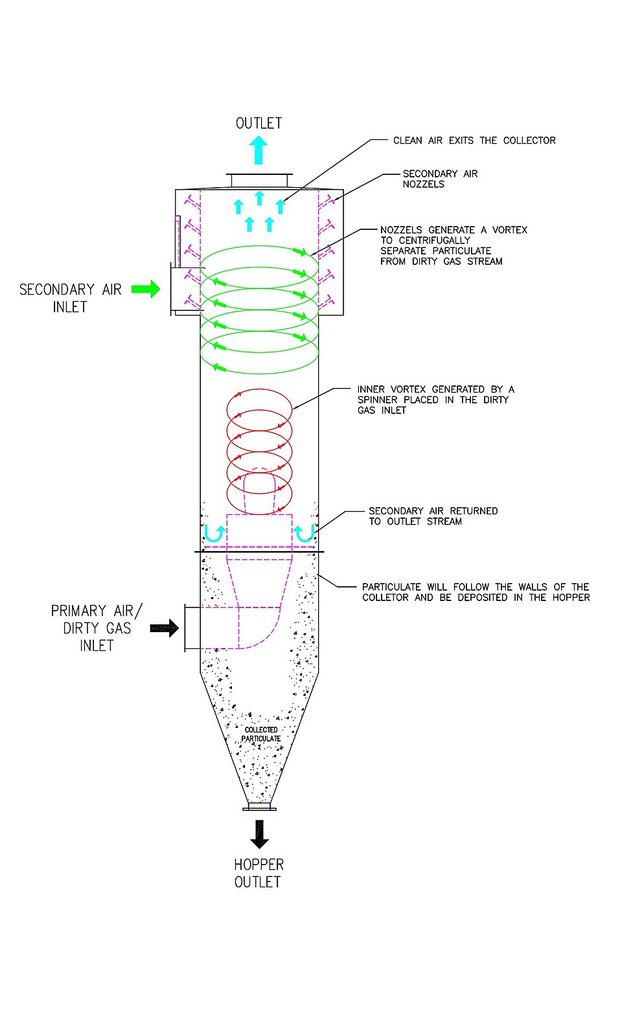
Although designs vary, most conventional cyclone separators share several important components.
Inlet
The inlet directs dust-laden air into the chamber, usually tangentially. Its dimensions and position influence the initial velocity and direction of the airflow.
A poorly designed inlet can disrupt the intended vortex and reduce separation performance.
Cylindrical Body
The cylindrical upper section provides space for the incoming air to begin rotating. It establishes the main upper portion of the cyclone’s flow pattern.
The body’s diameter and height influence how the air circulates and how much opportunity particles have to migrate toward the outer wall.
Conical Section
The cone narrows toward the dust discharge. It guides the outer vortex downward and helps direct separated particles toward the collection point.
Cone geometry influences the flow pattern, so changing its dimensions can alter performance.
Vortex Finder and Outlet
The vortex finder is a central tube near the top of many cyclone designs. It guides the inner upward-moving airflow toward the outlet.
Its diameter, insertion depth, and position affect the internal flow. An unsuitable outlet arrangement can allow more dust to escape with the air or create excessive resistance.
Collection Bin or Hopper
The collection bin receives the separated material.
In a small workshop, this may be a bucket or a purpose-built container. Industrial systems often use larger hoppers and controlled discharge arrangements.
The connection between the separator and the bin needs to be properly sealed. Air leaking through the collection area can disturb the downward movement of debris and carry collected dust back into the airflow.
Suggested image placement: Include an annotated cutaway diagram identifying the inlet, cylindrical body, cone, vortex finder, outlet, and collection hopper.
What Types of Dust Can a Cyclone Separator Remove?
Cyclone separators are particularly useful for removing relatively coarse particles from moving air. Their effectiveness decreases as particles become harder to separate from the airflow.
The following table provides a general guide. Actual results depend on the separator design, particle properties, and operating conditions.
| Material or particle type | General suitability |
|---|---|
| Wood chips and shavings | Usually very good |
| Coarse sawdust | Often good |
| Large particles from sanding or cutting | Depends on particle size and system design |
| Fine sanding dust | Variable; some can escape |
| Very fine airborne dust | Requires suitable downstream filtration |
| Sticky or damp debris | May cause buildup or operating problems |
These categories are not guarantees of collection efficiency. A cyclone designed for industrial particles may perform differently from a compact separator connected to a shop vacuum.
For woodworking, the distinction between visible debris and invisible fine dust is especially important. A workshop can look clean while still containing airborne particles that require effective filtration and source capture.
A cyclone should not be treated as a stand-alone air-cleaning device unless the entire system has been specifically designed and verified for that purpose.
Why Do Fine Dust Particles Escape a Cyclone?
One of the most common misconceptions about cyclone separators is that they capture all dust because the air spins rapidly.
In reality, the separator has a particle-size-dependent collection efficiency. Some particles are captured readily, while others remain in the air stream.
Fine particles have relatively little inertia and can follow changes in airflow direction. If they remain entrained in the inner vortex, they may leave through the outlet instead of reaching the collection bin.
Several factors influence how much dust escapes:
- Particle size: Smaller particles are generally more difficult to separate.
- Particle density: Dense particles often respond differently from lightweight particles of similar size.
- Particle shape: Fibrous, flat, or irregular particles may behave differently from compact particles.
- Inlet velocity: Airflow that is too low or too high for the design can reduce performance.
- Cyclone geometry: Body diameter, cone dimensions, inlet area, and outlet size affect separation.
- Air leaks: Leaks around the dust discharge or collection bin can disturb the intended flow.
- Dust loading: A heavy or changing dust load can affect operating behavior.
For this reason, there is no single collection-efficiency percentage that applies to every cyclone separator.
A manufacturer may report a specific efficiency under defined test conditions. That figure should not automatically be applied to a different separator, material, or airflow rate.
What Is the Difference Between a Cyclone Separator, a Dust Collector, and an Air Filter?
These terms are related, but they do not describe exactly the same thing.
| Equipment | Main function | Typical role |
|---|---|---|
| Cyclone dust separator | Separates particles through rotating airflow | Removes a portion of the dust before filtration |
| Dust collector | Moves and collects dust using a fan or blower and a collection system | Captures dust generated by tools or industrial processes |
| Air filter | Traps particles as air passes through a filtering medium | Captures particles that remain in the air stream |
| Air cleaner | Filters airborne particles from room air | Reduces airborne dust already present in a space |
A cyclone is often one component of a complete dust collection system rather than a complete system by itself.
For example, a woodworking shop may use a cyclone separator ahead of a dust collector. The cyclone removes much of the coarse debris, while the downstream filter captures particles that remain.
A separate ambient air cleaner may then help capture dust that escaped at the source and entered the room.
These components serve different purposes, and none should be assumed to replace the others in every application.
Single-Stage vs. Two-Stage Dust Collection
Dust collection systems are commonly described as single-stage or two-stage, although terminology can vary between manufacturers.
In a typical single-stage arrangement, dust-laden air travels directly to the collection equipment, where the material is separated and the air is filtered as part of the same collector.
In a two-stage arrangement, a cyclone or another separator removes a substantial portion of the debris before the air reaches a separate filter or collector.
A small workshop might use a shop vacuum with an inline cyclone separator. An industrial installation might use a cyclone ahead of a baghouse or cartridge collector.
The main advantage of two-stage collection is that the downstream filter receives less coarse material. This can reduce filter loading and make maintenance easier.
However, adding a cyclone also introduces resistance to airflow. The vacuum or blower must be capable of moving enough air through the complete system, including hoses, ducts, the separator, and the filter.
A poorly matched separator can reduce airflow at the tool, potentially making the overall dust collection system less effective.
What Are the Benefits of a Cyclone Dust Separator?
Less debris reaches the filter
By removing much of the coarse material before it reaches the filter, a cyclone can reduce the rate at which the filter loads with dust and chips.
Easier collection and disposal
In a workshop setup, the separated material collects in a dedicated bin. Depending on the design, this can make emptying the system more convenient.
No moving parts inside a conventional cyclone
The separation chamber itself typically has no motor, fan, or rotating mechanical component. The vacuum or blower provides the airflow.
This relatively simple construction can reduce maintenance requirements for the separator itself.
Useful for woodworking applications
Saws, planers, routers, and sanders can generate mixtures of chips, shavings, and fine dust. A cyclone can help separate the coarser fraction before the air reaches the filter.
Suitable for different scales
Cyclone separators are available in compact workshop designs as well as larger industrial configurations. The appropriate design depends on airflow, dust characteristics, available space, and filtration requirements.
What Are the Limitations of a Cyclone Dust Separator?
Despite its advantages, a cyclone is not a perfect solution for every dust collection problem.
It does not capture every particle
Fine dust can remain in the airflow and pass to the outlet. Appropriate downstream filtration is still necessary.
It adds airflow resistance
The cyclone creates pressure loss as air passes through its inlet, chamber, and outlet. The additional resistance can reduce airflow if the connected vacuum or blower cannot compensate.
Performance depends on design
A separator with unsuitable dimensions or poor internal geometry may not perform as expected. A homemade separator should not be assumed to match a professionally engineered unit.
Leaks can undermine separation
Air entering through unintended gaps near the collection bin can disturb the flow and potentially carry dust back into the cyclone.
Some materials create special challenges
Long fibrous material, sticky debris, and damp dust can accumulate or block parts of a separator. Certain industrial dusts also require specialized collection and handling equipment.
Common Cyclone Dust Separator Problems and Their Causes
Understanding common problems can help explain why a separator sometimes performs poorly even when its basic design is sound.
| Problem | Possible cause | What to check |
|---|---|---|
| Dust appears at the outlet | Fine particles escaping or poor separation | Downstream filter, airflow, and separator design |
| Suction seems weak | Excessive resistance, leaks, or blocked hoses | Hose routing, filter condition, and connections |
| Dust accumulates around the bin connection | Poor seal or disturbed discharge flow | Gaskets, lid fit, and collection-bin attachment |
| Collection bin deforms | Container cannot withstand the vacuum | Use a suitable vacuum-rated container |
| Dust builds up inside the cone | Material bridging, moisture, or unsuitable geometry | Dust characteristics and discharge opening |
| Filter still clogs frequently | High fine-dust load or inadequate separation | Filter type, airflow, tool capture, and separator suitability |
Troubleshooting should begin with the entire system, not just the cyclone. A clogged filter, undersized hose, poor tool connection, or leaking duct can all affect collection performance.
Never assume that adding a cyclone will correct an undersized or poorly configured dust collection system.
How to Improve Cyclone Dust Separator Performance
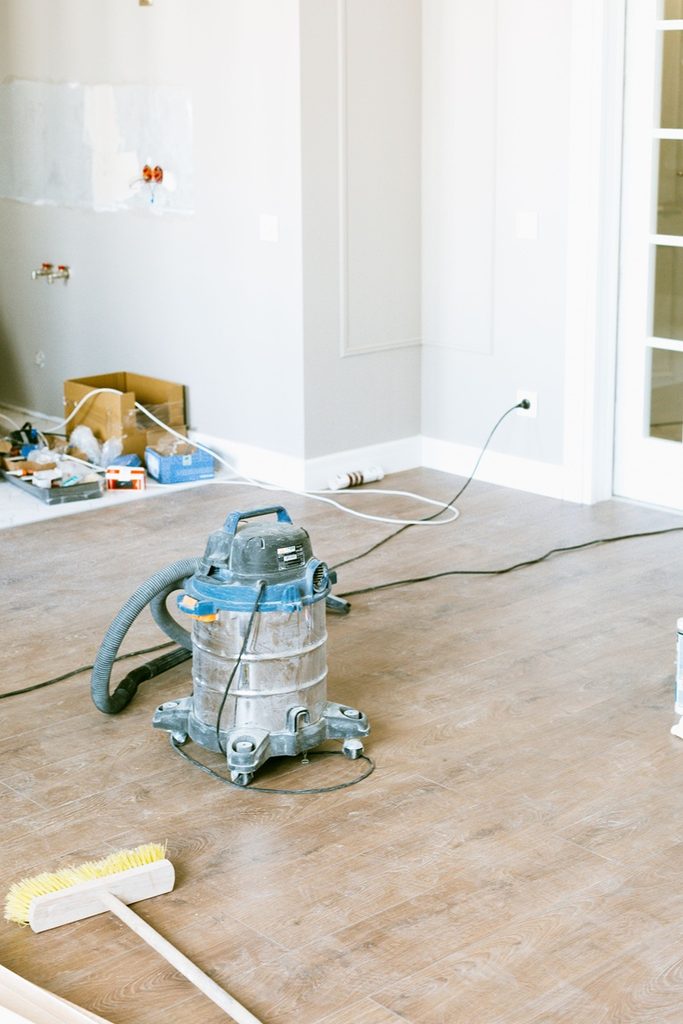
The most effective improvements depend on the specific system, but several general principles apply.
1. Match the separator to the airflow. Choose a design suited to the vacuum or blower and the tool being used. A separator that is too restrictive can reduce airflow at the source.
2. Keep connections airtight. Check the inlet, outlet, lid, gaskets, and collection-bin interface. Unintended leaks can interfere with the flow pattern.
3. Use suitable hoses and ductwork. Excessively restrictive hoses, abrupt changes in direction, and poorly matched fittings can reduce the air volume delivered to the separator.
4. Maintain the downstream filter. A dirty or clogged filter can reduce airflow even if the cyclone is working correctly.
5. Empty the collection bin appropriately. Do not allow collected material to interfere with the separator’s discharge arrangement or exceed the container’s safe capacity.
6. Use effective final filtration. Select filtration appropriate for the particle size and application. A cyclone alone should not be relied upon to protect people from fine airborne dust.
7. Evaluate performance under real operating conditions. If the system does not capture dust effectively at the tool, inspect the whole airflow path and consult the equipment manufacturer’s guidance.
Safety Considerations for Woodworking Dust
Woodworking dust is not merely a housekeeping issue. Fine airborne particles can be inhaled, and some types of wood dust present additional health hazards.
A cyclone can reduce the amount of debris reaching a downstream filter, but it does not guarantee that the exhaust air is safe to breathe.
Use suitable dust capture at the tool, an appropriately rated filtration system, and adequate ventilation. Avoid exhausting unfiltered dust into occupied indoor spaces.
Also consider the fire and explosion hazards associated with combustible dust. Fine wood dust can become hazardous when dispersed in air and exposed to an ignition source. Industrial systems handling combustible dust may require specialized equipment, grounding and bonding, explosion protection, and other controls based on a professional hazard assessment.
For a homemade system, use a sturdy collection container designed for the operating pressure. Inspect hoses and fittings regularly, and follow the instructions supplied with the vacuum, separator, and filter.
Frequently Asked Questions
1. Does a cyclone dust separator need a filter?
A cyclone itself does not usually require a filter inside its separation chamber. However, the complete dust collection system generally needs suitable filtration to capture particles that escape the cyclone, particularly when the air returns to an occupied indoor space.
2. Does a cyclone dust separator increase suction?
No. A cyclone does not generate suction. A vacuum or blower moves the air. Adding a cyclone introduces resistance, so the resulting airflow may decrease depending on the equipment and system design.
3. Can a cyclone dust separator remove fine dust?
It can capture some fine particles, but performance depends on particle size, density, airflow, and cyclone geometry. Very fine particles are generally more difficult to separate than coarse debris, so suitable downstream filtration remains important.
4. Why does a cyclone separator have a cone?
The cone helps guide the outer downward airflow and separated particles toward the dust discharge. Its shape influences the internal flow and overall separation performance.
5. Why does a cyclone separator have two airflow paths?
A conventional reverse-flow cyclone develops an outer vortex moving downward and an inner vortex moving upward. The outer flow helps carry separated particles toward the collection bin, while the inner flow carries the remaining air toward the outlet.
6. Is a cyclone dust separator better than a regular shop-vac filter?
They perform different jobs. A cyclone removes a portion of the incoming debris before it reaches the filter, while the filter captures additional particles. Using both can reduce filter loading, but the benefit depends on the application and the added airflow resistance.
7. Can I use a cyclone separator with a shop vacuum?
Yes. Compact cyclone separators are commonly used with shop vacuums, provided the separator, hoses, fittings, and collection container are compatible with the vacuum’s airflow and pressure conditions.
8. Why is dust escaping from my cyclone separator?
Possible reasons include fine particles passing through naturally, an unsuitable separator design, poor airflow, leaks around the collection bin, or problems with the downstream system. Check the full setup before assuming the cyclone itself is defective.
9. Does a larger cyclone always work better?
No. A larger cyclone may handle a different airflow volume, but collection efficiency depends on the design and operating conditions. Diameter, inlet dimensions, outlet geometry, and pressure drop all influence performance.
10. Is a cyclone separator suitable for every type of dust?
No. It is useful for many coarse-particle applications, but sticky, fibrous, hazardous, or very fine materials may require specialized equipment. The material’s characteristics and the risks associated with collecting it should be evaluated before selecting a separator.
Conclusion
A cyclone dust separator works by directing dust-laden air into a rotating flow. Particle inertia and centrifugal effects cause many of the larger particles to migrate toward the outer wall, while the airflow carries separated material downward and the remaining air toward an outlet.
Its main advantage is that it removes a substantial portion of the coarse debris before the air reaches a downstream filter. This can reduce filter loading and make dust collection more convenient.
However, a cyclone is only one part of an effective dust collection system. Its performance depends on the separator’s geometry, airflow, particle characteristics, sealing, and the filtration equipment used afterward.
For a woodworking shop, the best results come from matching the cyclone to the vacuum or dust collector, maintaining airtight connections, capturing dust at the source, and using suitable final filtration.
Understanding these principles makes it easier to choose an appropriate separator, troubleshoot poor performance, and decide whether a commercial unit or a DIY design is right for your workshop.
Read more best dust separator for small workshop